The Yard Manoeuvres
Three-Point Turn cont.
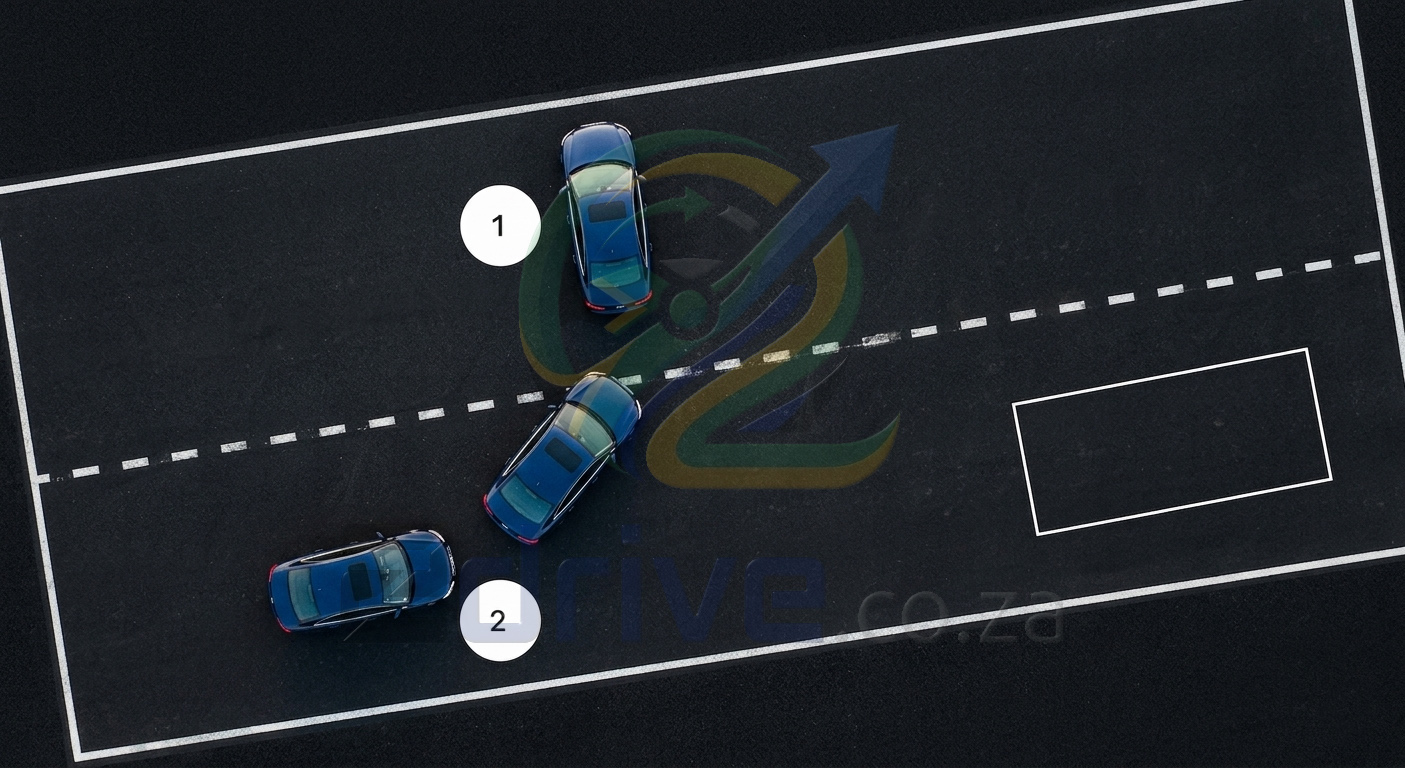
Movement 2: Reverse (The Second Turn)
Once the vehicle is secure after the first forward movement, you must prepare to reverse across the roadway.
Absolute situational awareness is critical during this stage.
Pre-Moving Routine and Observation
1. Check your mirrors to assess the space behind you.
2. Check your left blind spot to ensure the area on your left is clear.
3. Signal left to indicate your intention to reverse into the left lane.
4. Select reverse gear.
5. Conduct a full 360-degree observation (mirrors and both blind spots) to confirm no pedestrians, vehicles, or hazards have entered your path.
Executing the Maneuver
Release the parking brake (if it was applied). 6.Move backwards slowly and under control while steering sharply to the left.
7. Counter-steer to the right just before coming to a stop.
8.This pre-positions your front wheels, making your final forward movement much smoother.
Securing the Vehicle
Bring the vehicle to a complete stop before touching the rear kerb or boundary line.
Apply the parking brake and select neutral (or Park for automatic vehicles).

![Enlarged view]()
Movement 3: Forward (The Final Turn and Exit)
Once the vehicle is secure after the reverse movement, you must complete the final forward turn to exit the demarcated area on the left-hand side of the road.
Pre-Moving Routine and Observation
1. Check your mirrors (rear-view and side mirrors).
2. Check your right blind spot to ensure your turning path is clear.
3. Signal right to indicate your intention to move off.
4. Select 1st gear.
5. Obtain clutch control (or prepare the accelerator for automatic vehicles).
6. Conduct a full 360-degree observation (mirrors and both blind spots) to ensure no new hazards have appeared around the vehicle.
Executing the Maneuver
7. Release the parking brake (if it was applied).
8. Move forward slowly, steering smoothly to the left to align your vehicle correctly within the left lane.
9. Cancel your signal once the vehicle is straight and the turn is fully complete.
Movement 2: Reverse (The Second Turn)
Once the vehicle is secure after the first forward movement, you must prepare to reverse across the roadway.
Absolute situational awareness is critical during this stage.
Pre-Moving Routine and Observation
1. Check your mirrors to assess the space behind you.
2. Check your left blind spot to ensure the area on your left is clear.
3. Signal left to indicate your intention to reverse into the left lane.
4. Select reverse gear.
5. Conduct a full 360-degree observation (mirrors and both blind spots) to confirm no pedestrians, vehicles, or hazards have entered your path.
Executing the Maneuver
Release the parking brake (if it was applied). 6.Move backwards slowly and under control while steering sharply to the left.
7. Counter-steer to the right just before coming to a stop.
8.This pre-positions your front wheels, making your final forward movement much smoother.
Securing the Vehicle
Bring the vehicle to a complete stop before touching the rear kerb or boundary line.
Apply the parking brake and select neutral (or Park for automatic vehicles).
Movement 3: Forward (The Final Turn and Exit)
Once the vehicle is secure after the reverse movement, you must complete the final forward turn to exit the demarcated area on the left-hand side of the road.
Pre-Moving Routine and Observation
1. Check your mirrors (rear-view and side mirrors).
2. Check your right blind spot to ensure your turning path is clear.
3. Signal right to indicate your intention to move off.
4. Select 1st gear.
5. Obtain clutch control (or prepare the accelerator for automatic vehicles).
6. Conduct a full 360-degree observation (mirrors and both blind spots) to ensure no new hazards have appeared around the vehicle.
Executing the Maneuver
7. Release the parking brake (if it was applied).
8. Move forward slowly, steering smoothly to the left to align your vehicle correctly within the left lane.
9. Cancel your signal once the vehicle is straight and the turn is fully complete.