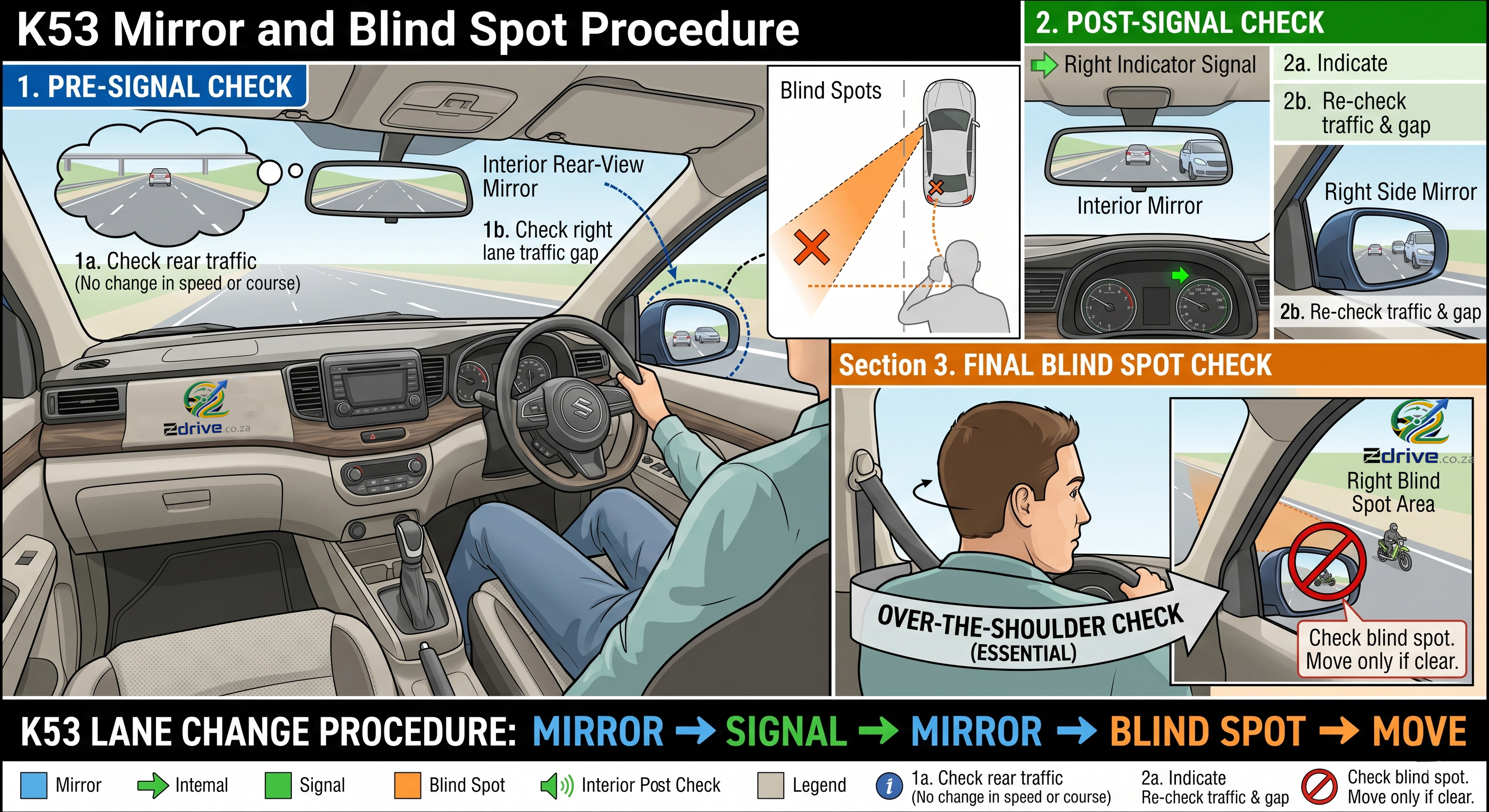
Mirror Observation Sequence
Introduction
The K53 Mirror Observation Sequence is the fundamental safety protocol required for every maneuver during the South African driving test. It ensures that a driver maintains a constant, 360-degree awareness of their surroundings before changing the vehicle's speed or direction.
The test is conducted according to the official K53 driving standard and is aimed at ensuring that every driver can operate a vehicle safely, responsibly, and confidently while obeying the rules of the road.
Whether you are preparing for a light motor vehicle licence or a heavy motor vehicle licence, understanding what is expected during the test can greatly improve your chances of passing successfully.
Mirror Adjustment and Handling
Proper setup is the foundation of the Mirror - Signal - Maneuver routine.
- Stationary Adjustment: You must adjust all mirrors to ensure maximum rear-view vision only while the vehicle is stationary
- Adjustments While Moving: You will not be penalized for making a "quick, minor adjustment" to the rear-view mirror while driving. However, any significant adjustment made while the vehicle is in motion will result in penalty points.
- Proper Grip: When adjusting, avoid leaving fingerprints on the glass, as this can obscure your vision and shows a lack of professional care during the test.
Observation Frequency and Timing
- Observation must be constant and purposeful to avoid "poor observation" penalties.
- The 5 to 8 Second Rule: You should check your rear-view mirrors every 5 to 8 seconds to maintain a "mental map" of the traffic behind you.
- Approaching Hazards: Always check your mirrors as you approach any potential hazard (such as intersections, pedestrian crossings, or narrowed roads) to ensure you can brake or swerve safely if needed.
- Duration of Glance: You must look in the mirror long enough to accurately determine the traffic situation behind you.
- Avoid "Staring": Do not look into the mirrors for an extended period while moving; doing so will result in a penalty for poor observation, as your primary focus must remain on the road ahead
Mirror Specifics and Requirements
- The type of vehicle and the environment dictate which mirrors are prioritized.
- Enclosed Cabins: YIf you are driving a vehicle with an enclosed cabin (such as a truck or a van where the interior mirror is obstructed), you must check both exterior rear-view mirrors.
- Interior vs. Exterior:
- Generally, you are not strictly required to use exterior mirrors for standard "observation" to the rear if the interior mirror is sufficient.
- However, if the vehicle lacks an interior mirror, or if that mirror provides inadequate vision, the use of exterior mirrors becomes mandatory for the test.
- The Blind Spot: Remember that mirrors alone are insufficient for lane changes or pulling off; they must always be supplemented by a physical shoulder check to cover areas the mirrors cannot see.