Detailed Overview - Road Test
3. Road Test Requirements
Every official driving test route must contain specific road and traffic conditions to ensure that all applicants are assessed fairly and consistently.
4. Multi Lane Road Section
The test route must include:
A road with more than one lane travelling in the same direction.
Clearly marked lane divisions.
At least two controlled intersections.
5. Four Way Stop Intersection
The route must include at least one intersection controlled by four-way stop signs.
At these intersections, the examiner will assess whether the applicant:
Comes to a complete stop behind the stop line.
Observes all directions properly.
Understands right-of-way rules.
Proceeds safely and confidently.
6. Stop Signs and Traffic Lights
The route must include at least four intersections controlled by:
Stop signs, or
Traffic lights.
7. Yield Sign Intersections
The route must contain at least two intersections controlled by yield signs.
These intersections must include:
One situation where the applicant must yield right of way.
One situation where the applicant has right of way.
8. Emergency Stop Area
The route must include a quiet road or low traffic area where the examiner can instruct the applicant to perform an emergency stop.
During this manoeuvre, the examiner will evaluate:
Reaction time.
Vehicle control.
Proper braking technique.
Observation before moving off again.
8. Intersection Repitition Rule
To ensure fairness and route variety:
No intersection forming part of the test route may be crossed more than twice from the same direction.
9. Urban Road Requirement
At least 65% of the road test must take place on public roads within an urban area.
Urban driving allows the examiner to assess:
Interaction with traffic.
Pedestrian awareness.
Speed control.
Traffic sign compliance.
General defensive driving skills.
10. Crossing Two Way Traffic
The route must contain at least two intersections where the applicant is required to cross two-way traffic.
This tests the applicant's ability to:
Judge traffic gaps correctly.
Assess vehicle speed and distance.
Cross safely without causing danger or obstruction.
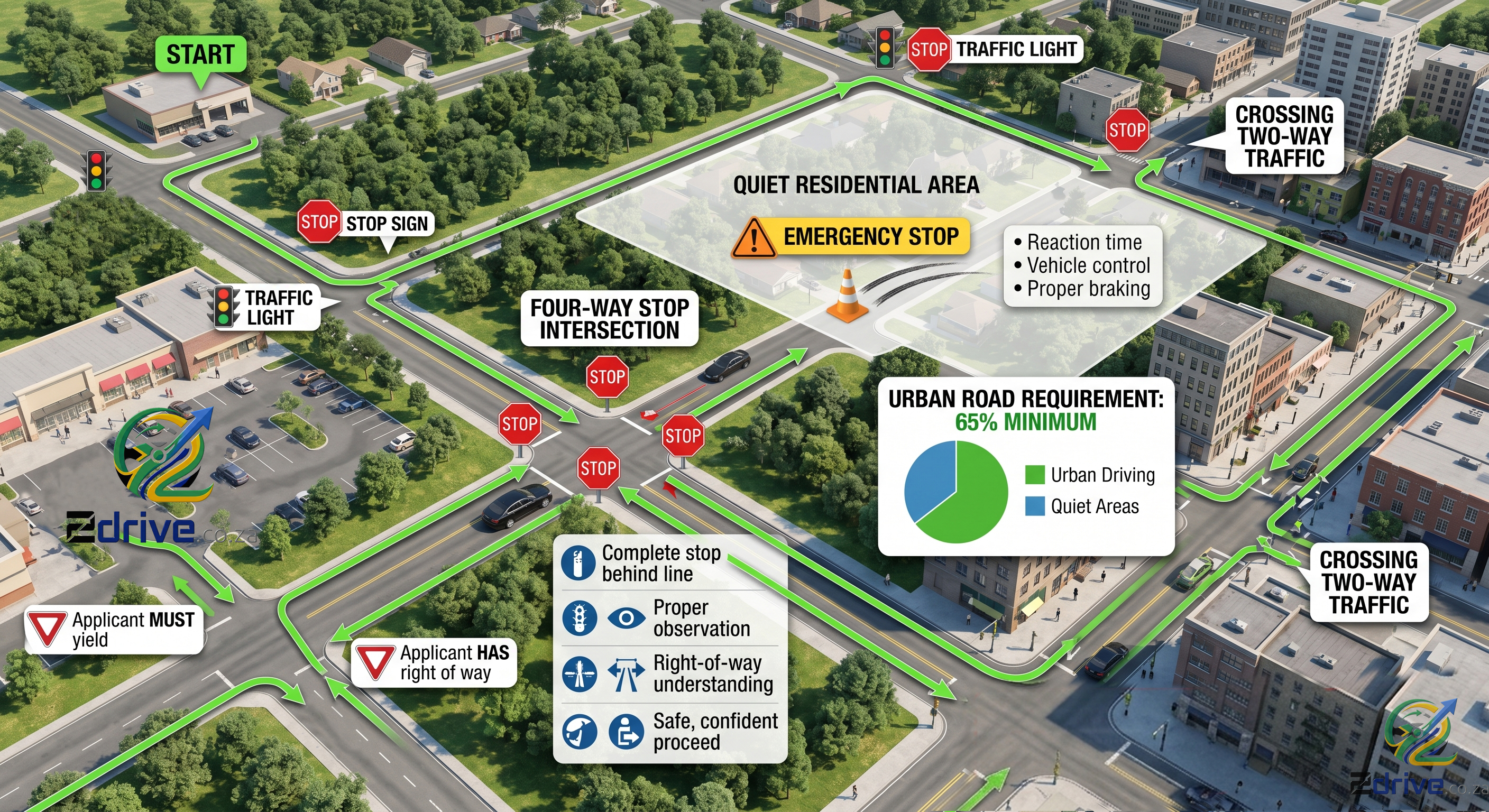
Every official driving test route must contain specific road and traffic conditions to ensure that all applicants are assessed fairly and consistently.
4. Multi Lane Road Section
The test route must include:
5. Four Way Stop Intersection
The route must include at least one intersection controlled by four-way stop signs.
At these intersections, the examiner will assess whether the applicant:
6. Stop Signs and Traffic Lights
The route must include at least four intersections controlled by:
7. Yield Sign Intersections
The route must contain at least two intersections controlled by yield signs.
These intersections must include:
8. Emergency Stop Area
The route must include a quiet road or low traffic area where the examiner can instruct the applicant to perform an emergency stop.
During this manoeuvre, the examiner will evaluate:
8. Intersection Repitition Rule
To ensure fairness and route variety:
9. Urban Road Requirement
At least 65% of the road test must take place on public roads within an urban area.
Urban driving allows the examiner to assess:
10. Crossing Two Way Traffic
The route must contain at least two intersections where the applicant is required to cross two-way traffic.
This tests the applicant's ability to: