Driving Procedures - Stopping
STOPPING IN TRAFFIC
Stopping in traffic is one of the most important driving skills taught during driver training and assessed during the driving test.
A safe and controlled stop demonstrates good observation, vehicle control, hazard awareness, and defensive driving techniques.
Drivers are expected to stop smoothly and safely while remaining fully aware of surrounding traffic conditions.
The parking brake should be applied when for any length of time or where there is a possibility of rolling
Incorrect stopping procedures may lead to:
- Rear-end collisions
- Loss of vehicle control
- Rolling accidents
- Traffic obstruction
- Test penalties or failure
The ability to stop correctly is essential in everyday driving situations such as:
- Traffic lights
- Stop streets
- Congested traffic
- Pedestrian crossings
- Intersections
- Emergency traffic conditions
Procedure
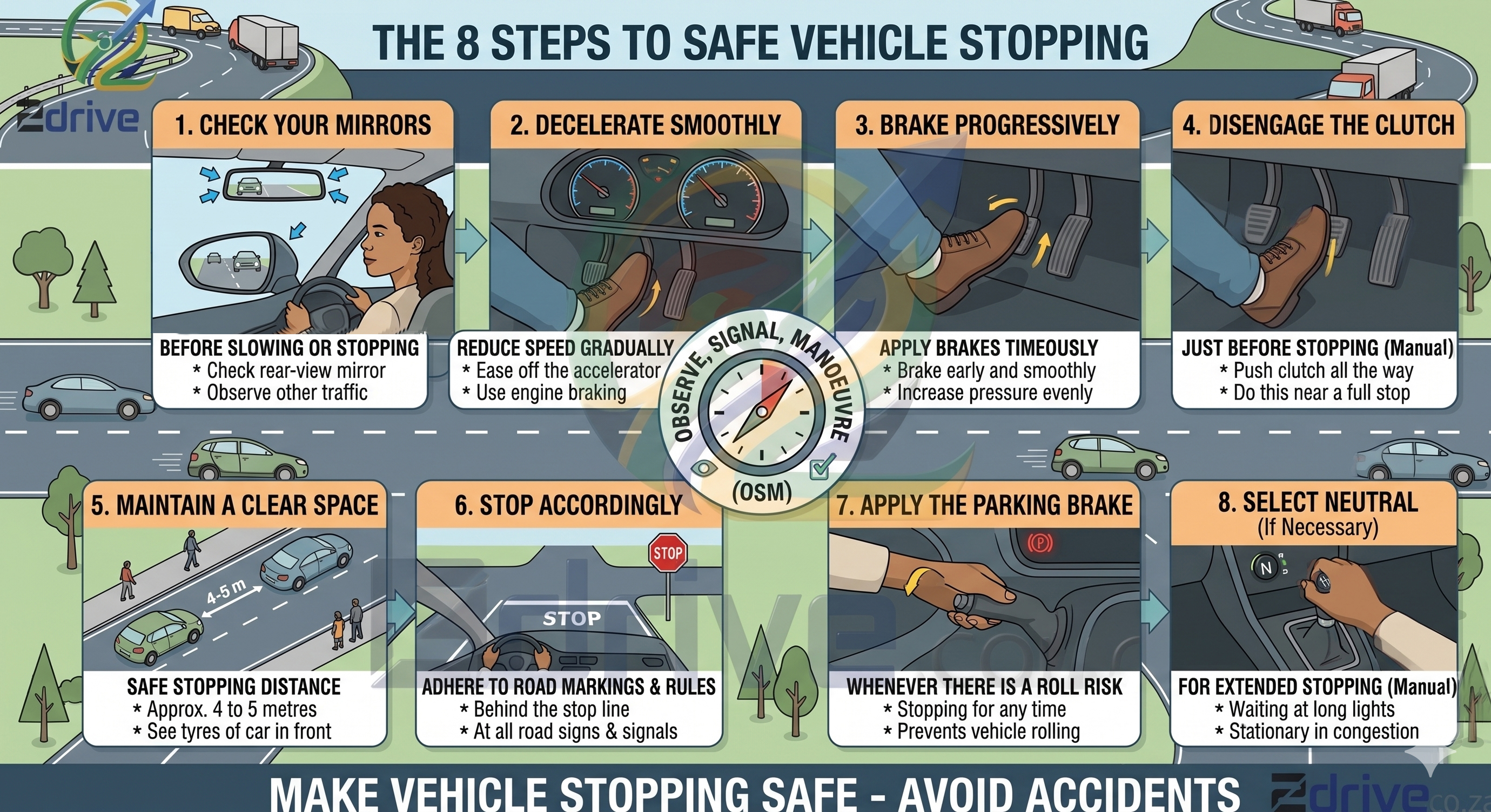
- 1. Check in the Rear-View Mirror
Before slowing down or stopping, the driver must check the rear-view mirror.
- 2. Decelerate
The driver should begin reducing speed gradually by easing off the accelerator.
- 3. Brake Timeously, Smoothly, and Progressively
Braking should be applied early enough.
- 4. Disengage the Clutch Just Before Stopping
In a manual vehicle, the clutch should only be disengaged shortly before the vehicle comes to a complete stop.
- 5. Maintain a Clear Space
When stopping behind another vehicle, maintain a safe following distance of approximately,4 to 5 metres behind the vehicle ahead.
- 6. Stop According to Traffic Signals, Rules, and Road Markings
The vehicle must stop:
Behind the stop line
In compliance with road signs
According to traffic light signals
Without obstructing intersections or pedestrian crossings
- 7. Apply the Parking Brake
The parking brake should be applied:
Whenever stopping for any length of time
Whenever there is a risk of rolling
- 8. Select Neutral, If Necessary
In manual vehicles, neutral may be selected when:
Stopped for an extended period
Waiting at long traffic lights
Remaining stationary in traffic congestion