Abbreviations and Terms
Abbreviations and Terms cont.
Position vehicle:
Steer to the position applicable for the maneuver.
This could be moving into the correct lane or the correct side of the road, or positioning the vehicle for parking, or to the starting position for the next maneuver in the yard test.
Apply parking break:
Most vehicles use a handbrake as the parking brake.
When applying the parking brake, first press in the release button to reduce wear and tear on the release mechanism.
(For a foot-operated parking brake there is no release button.)
Release parking break:
Release the parking break so that the vehicle is free to move.
Clear space:
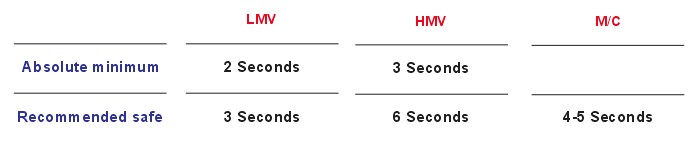
Maintain a clear space around the vehicle, front, rear and sides, to reduce the chance of a collision. Maintain a safe following distance behind the vehicle ahead of you.
![Enlarged view]() Obtain clutch control:
Obtain clutch control:
Release the clutch pedal slowly to the point where the clutch starts to 'take' and the vehicle will not roll back or forwards.
Disengage clutch:
Take your foot completely off the clutch pedal and rest it on the floor, away from the pedal.
Steer:
Steer the vehicle in the direction in which you need to move.
Counter steer:
Counter steering means turning the steering wheel hard in the opposite direction to which it has just been turned. It is usually done when the steering has been turned quite sharply in one direction e.g. when parking, or turning in the road.
Position vehicle:
Steer to the position applicable for the maneuver.
This could be moving into the correct lane or the correct side of the road, or positioning the vehicle for parking, or to the starting position for the next maneuver in the yard test.
Apply parking break:
Most vehicles use a handbrake as the parking brake.
When applying the parking brake, first press in the release button to reduce wear and tear on the release mechanism.
(For a foot-operated parking brake there is no release button.)
Release parking break:
Release the parking break so that the vehicle is free to move.
Clear space:
Maintain a clear space around the vehicle, front, rear and sides, to reduce the chance of a collision. Maintain a safe following distance behind the vehicle ahead of you.
Release the clutch pedal slowly to the point where the clutch starts to 'take' and the vehicle will not roll back or forwards.
Disengage clutch:
Take your foot completely off the clutch pedal and rest it on the floor, away from the pedal.
Steer:
Steer the vehicle in the direction in which you need to move.
Counter steer:
Counter steering means turning the steering wheel hard in the opposite direction to which it has just been turned. It is usually done when the steering has been turned quite sharply in one direction e.g. when parking, or turning in the road.