The Yard Manoeuvres
Three-Point Turn (Turn in the Road)
Applicable to Light Motor Vehicles Only
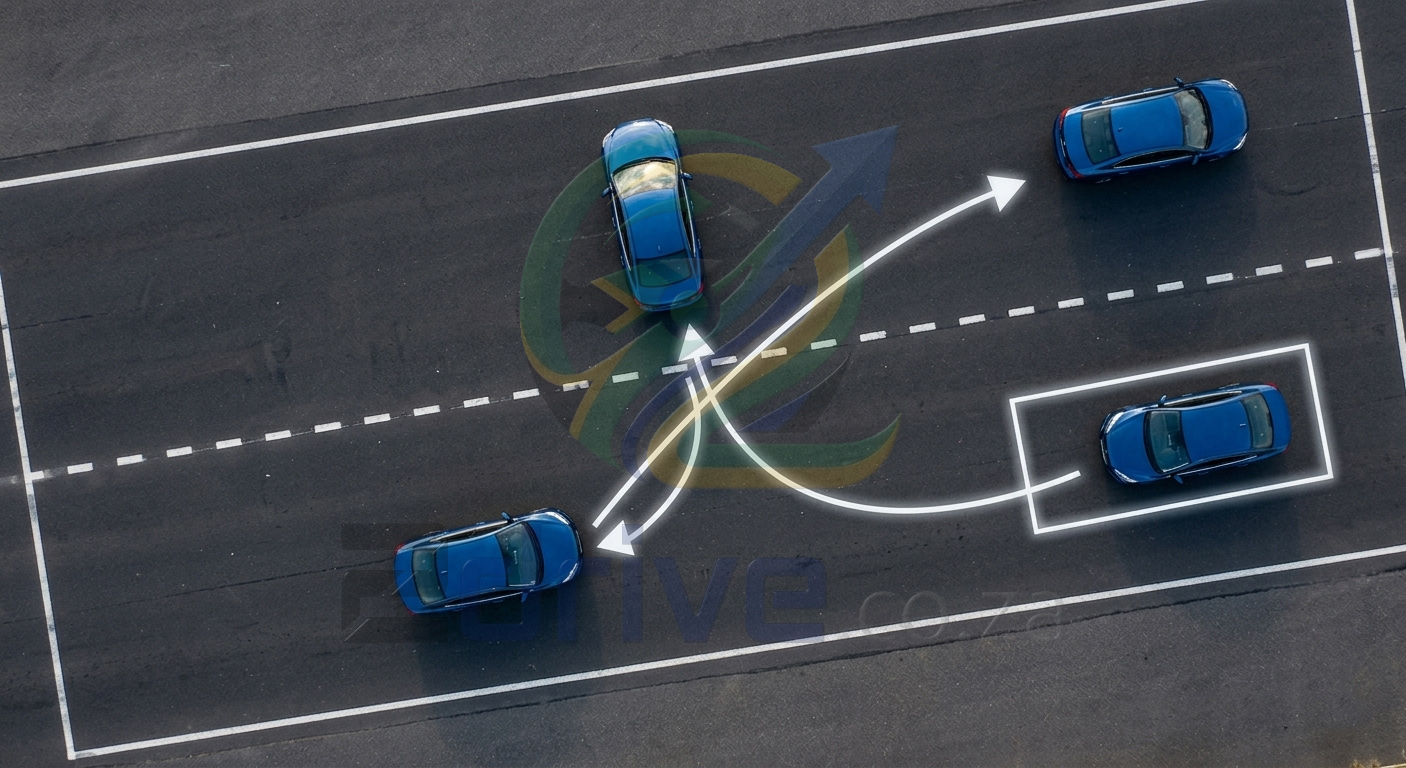
During your practical yard test, the examiner will instruct you to execute a turn in the road.
Understanding exactly what the examiner requires, and what actions will result in an immediate penalty, is key to passing this section smoothly.
Examiner Instructions and Requirements.
The examiner will give you the following specific directions:
Starting Position:
Position your vehicle at the designated starting point.
The 3 Movements:
Turn the vehicle completely around within the 12m roadway using exactly three movements,
forward,
reverse,
and forward again.
Final Position:
End up facing in the opposite direction, positioned correctly on the left-hand side of the road.
Exiting:
Complete the maneuver and exit the demarcated test area entirely on the left-hand side of the road.
Critical Mistakes to Avoid
To ensure you do not fail this module, you must strictly adhere to the following spacing rules:
Do not mount any kerb or touch any demarcated lines with any wheel.
Do not straddle the centre line once the maneuver is complete.
.
![Enlarged view]()
Movement 1: Forward (The First Turn)
Before moving the vehicle forward into the road, you must follow a strict sequence of observations and controls.
Pre-Moving Routine and Observation
1. Check your mirrors (rear-view and side mirrors).
2. Check your right blind spot to ensure the path is clear.
3. Signal right to indicate your intention to turn.
4. Select 1st gear.
5.Obtain clutch control (or prepare the accelerator for automatic vehicles).
6. Conduct a final check of all mirrors and both blind spots.
Executing the Maneuver
7. Release the parking brake.
8. Move forward slowly while turning the steering wheel as far as possible to the right.
9. Counter-steer sharply to the left just before coming to a stop. This pre-positions your wheels for the reverse movement.
Securing the Vehicle
10. Bring the vehicle to a complete stop before touching the opposite kerb or boundary line.
11. Apply the parking brake.
12. Select neutral (or Park for automatic vehicles).
Applicable to Light Motor Vehicles Only
During your practical yard test, the examiner will instruct you to execute a turn in the road.
Understanding exactly what the examiner requires, and what actions will result in an immediate penalty, is key to passing this section smoothly.
Examiner Instructions and Requirements.
The examiner will give you the following specific directions:
Starting Position:
Position your vehicle at the designated starting point.
The 3 Movements:
Turn the vehicle completely around within the 12m roadway using exactly three movements,
forward,
reverse,
and forward again.
Final Position:
End up facing in the opposite direction, positioned correctly on the left-hand side of the road.
Exiting:
Complete the maneuver and exit the demarcated test area entirely on the left-hand side of the road.
Critical Mistakes to Avoid
To ensure you do not fail this module, you must strictly adhere to the following spacing rules:
Movement 1: Forward (The First Turn)
Before moving the vehicle forward into the road, you must follow a strict sequence of observations and controls.
Pre-Moving Routine and Observation
1. Check your mirrors (rear-view and side mirrors).
2. Check your right blind spot to ensure the path is clear.
3. Signal right to indicate your intention to turn.
4. Select 1st gear.
5.Obtain clutch control (or prepare the accelerator for automatic vehicles).
6. Conduct a final check of all mirrors and both blind spots.
Executing the Maneuver
7. Release the parking brake.
8. Move forward slowly while turning the steering wheel as far as possible to the right.
9. Counter-steer sharply to the left just before coming to a stop. This pre-positions your wheels for the reverse movement.
Securing the Vehicle
10. Bring the vehicle to a complete stop before touching the opposite kerb or boundary line.
11. Apply the parking brake.
12. Select neutral (or Park for automatic vehicles).