Travelling Behind Other Vehicles
Safe Following Distance
Maintaining a safe following distance is one of the most important defensive driving skills.
A safe distance gives you enough time to react to sudden hazards, brake smoothly, and avoid collisions.
Following too closely, commonly known as "tailgating," greatly increases the risk of rear-end accidents and reduces your ability to respond safely to changing traffic conditions.
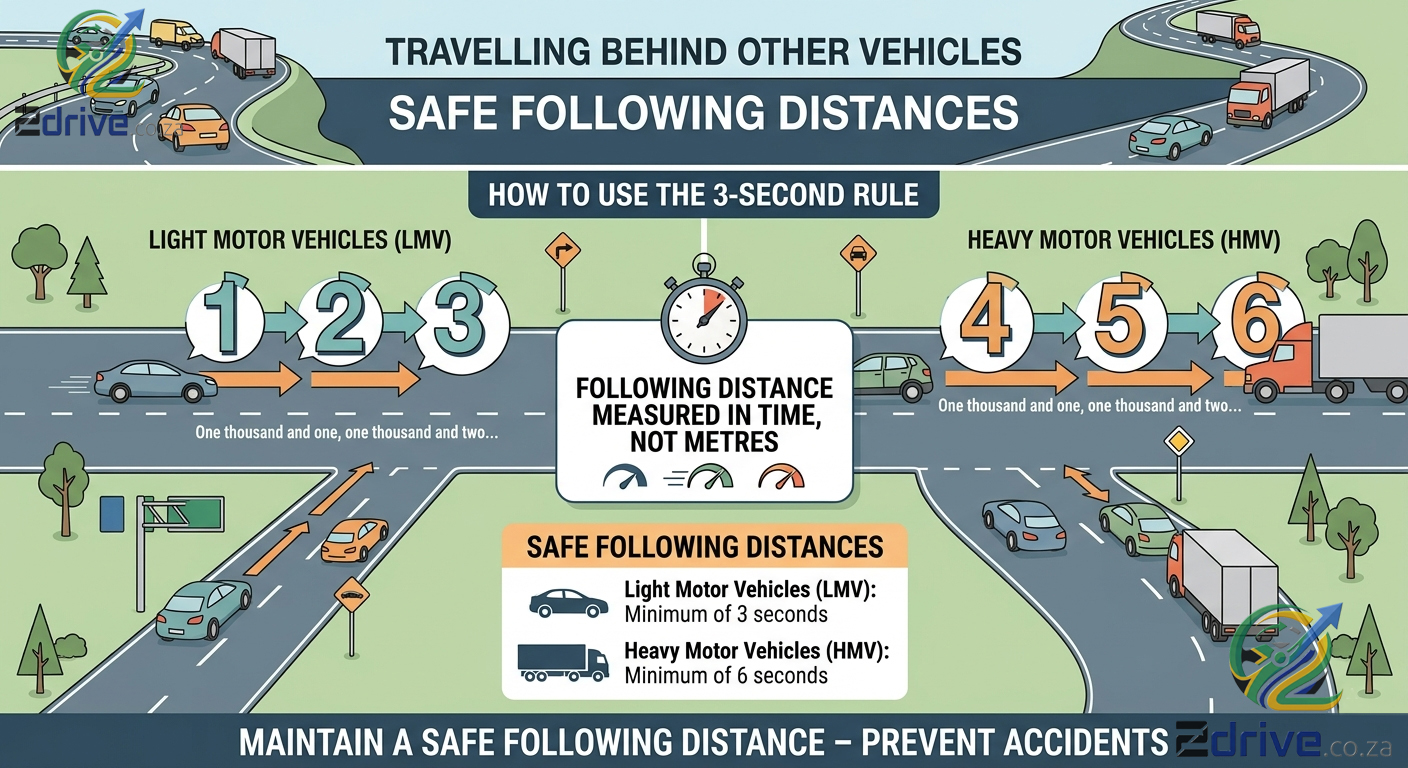
As a general guideline, drivers should maintain the following minimum safe following times:
A following distance is measured in time, not metres, because the safe gap changes according to your speed
How to Use the 3-Second Rule
To calculate a safe following distance:
Choose a fixed point ahead, such as a road sign, bridge, or tree.
When the vehicle in front passes that point, begin counting:
"One thousand and one, one thousand and two, one thousand and three."
If your vehicle reaches the same point before you finish counting, you are following too closely and must increase your distance.
Heavy motor vehicles should continue counting to at least six seconds.
- Wet or slippery roads
- Rain, fog, or poor visibility
- Heavy traffic congestion
- Driving at high speeds
- Carrying heavy loads or towing a trailer
- Gravel or uneven road surfaces
- Night driving
- When another vehicle is following too closely behind you
Increasing your following distance provides extra reaction and braking time, helping you maintain better control of your vehicle.
Increase Your Following Distance in Hazardous Conditions