Speed Management
The Speed Management exercise tests your ability to accelerate smoothly, shift gears efficiently, and bring the motorcycle to a controlled stop at a designated point using both brakes.The Procedure Step-by-Step
1. Start and Move Off.
Move on command.
The examiner will instruct you to move on command from point "A" along the specified path in the direction of point "D".
You must complete this path without touching any boundary lines.
2. Gear Change Up.
Up-shift smoothly.
Accelerate and change to a higher gear.
3. Accelerate to Target Speed.
Maintain pace.
Accelerate to approximately 25 km/h and maintain a steady speed.
4. Decelerate at Point C.
Apply both brakes.
When you reach point "C", reduce your speed evenly using both the front and rear brakes together without skidding.
5. Gear Change Down.
Down-shift.
Change to a lower gear.
6. Final Stop at Point D.
Precise stopping.
Bring the motorcycle to a complete stop with your front wheel positioned directly on cross point "D".
7. Stay Stationary.
Wait for instruction.
Do not move the motorcycle until the examiner has physically checked your final stopping point relative to the line.
Important Test Rules and Fail Criteria.
Boundary Violations.
Touching any boundary lines during the run results in a penalty or immediate failure.
Controlled Braking: Skidding while decelerating will cost you points, always ensure a smooth, even application of both levers.
The 3-Attempt Rule for Speed and Stopping.
If you ride too slowly or fail to stop within the prescribed distance from cross point "D", the K53 criteria allows you a strict buffer.
Three Strikes Policy.
You will be allowed 3 attempts only to get the speed and stopping distance correct. If you ride too slowly or miss the stopping mark on your third attempt, you will fail the test immediately and the test will be discontinued.
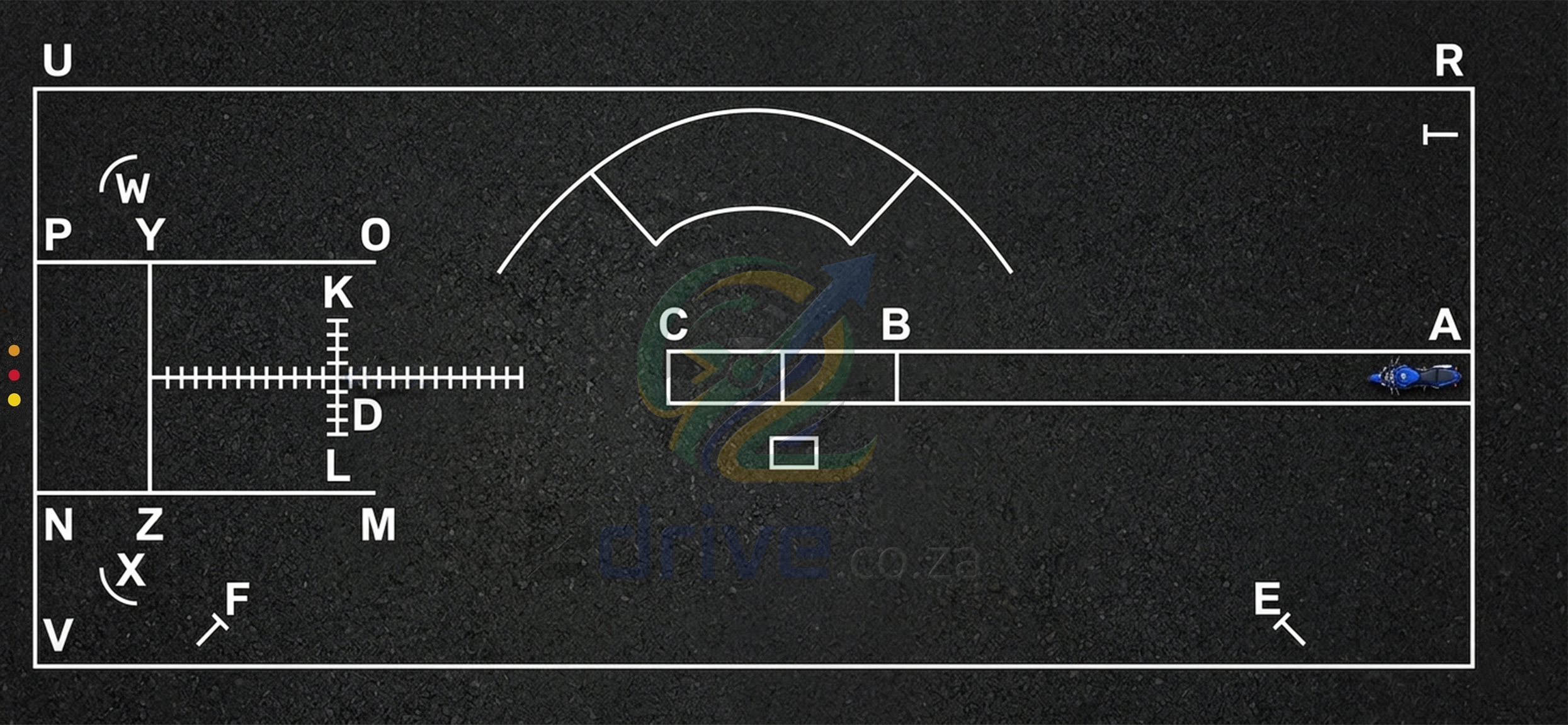
Speed Management Checklist
Ensure you execute these steps in exact chronological order when instructed by the examiner to begin the maneuver.
1. Observe.
Scan your surroundings.
Perform your full K53 observation routine (checking mirrors and blind spots) before initiating any movement.
2. Move Off.
Control the clutch.
Engage first gear and smoothly move off from the starting line.
3. Accelerate and Shift Up.
Gain momentum.
Accelerate cleanly along the path and change to a higher gear.
4. Avoid Boundary Lines.
Stay inside the track.
Maintain complete control of your path, do not touch or cross any boundary lines.
5. Brake at Line 'C'.
Initiate deceleration.
Apply both front and rear brakes smoothly as soon as you reach line "C".
6. Shift Down.
Prepare to stop.
Select a lower gear to keep the motorcycle stable and under control as you decelerate.
7. Precision Stop at Point 'D'.
Target the mark.
Bring the bike to a complete stop, ensuring your front wheel rests precisely on the cross point "D".
8. Maintain Balance and Hold Position.
Wait for the check.
Keep your feet planted, maintain your balance, and do not move the motorcycle forward or backward until the examiner has explicitly verified your final stopping position.
CRITICAL WARNING (Instant Fail).
When the motorcycle is meant to be completely stationary (both at the starting line and after you stop at cross point "D"), you must not allow the bike to roll backward or forward even an inch.
Allowing any uncontrolled rolling will result in an immediate FAIL, and the examiner will discontinue your test on the spot